Richmond
History No 29 (2008)
The
Journal of Richmond Local History Society
With the news that the Royal Star & Garter Home is off on its
travels, Richmond
History
has seized the opportunity to celebrate its colourful life on the crest
of Richmond Hill. The Star & Garter features in no
fewer than
three of the articles in the latest journal.
In
the 19th century the Star & Garter was the most glamorous hotel
in
Britain, the haunt of royalty and the literary establishment. John
Cloake’s article, ‘That Stupendous Hotel’, describes Dickens
celebrating the publication of David
Copperfield
there, with Tennyson and Thackeray among his guests. Thackeray
apparently found it a bit overwhelming: ‘where, if you go alone a
sneering waiter with his hair curled frightens you off the premises;
and where if ... you look out of the window you gaze on a view which is
so rich that it seems to knock you down with its splendour – a view
that has its hair curled like the swaggering waiter.’ This
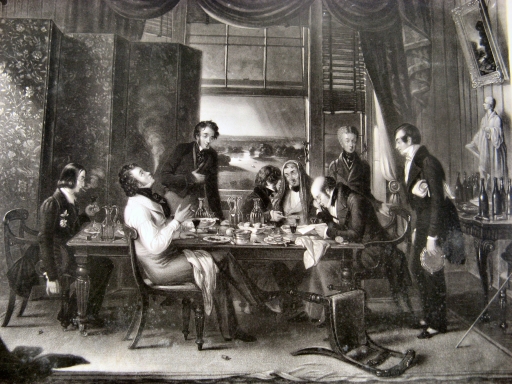
picture by Edward Prentice includes the famous view, along with a group
of Dickens’s carousing friends, in this case somewhat dismayed by the
size of the bill.
Judith
Church’s article, ‘The Royal Star & Garter Home’, describes how
the
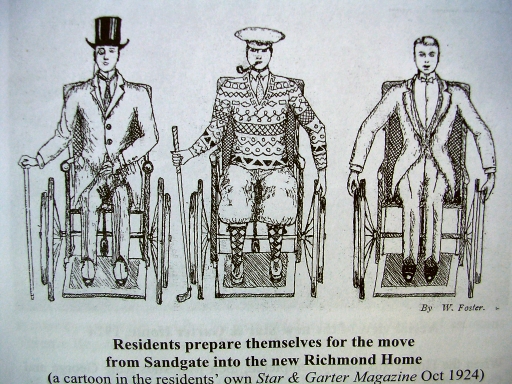
hotel then became the home for disabled heroes of World War I. They ran
their own magazine. This cartoon, drawn when they were waiting for the
home to be rebuilt in the 1920s, typifies their extraordinary courage
in the face of a lifetime of dependence. The last veteran of that war
died in 1996. The home survived to become a pioneering centre of
medical care and treatment for the disabled, generously supported by
royalty and by national personalities such as Vera Lynn, Thora Hird,
Bamber Gascoigne and Simon Weston.
VIPs were not always good
news. In Steven Woodbridge’s article on ‘Fifth-column fears
in
Richmond’ we find that in World War Two another VIP, famous in his time
and a governor of the Home, was imprisoned for his fascist
views.
Fascism, then as now, was still a force to be feared.
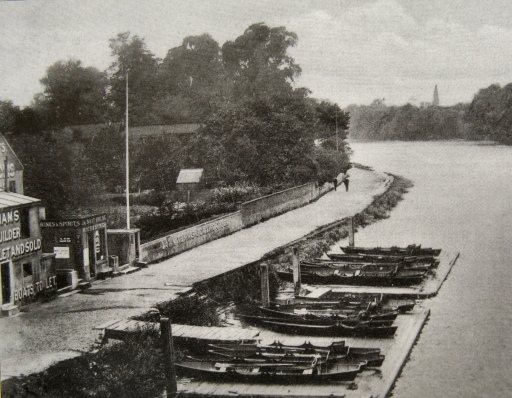
This
picture of hire boats lined up by Kew Bridge is a reminder of the huge
leisure trade run by the Williams family at the turn of the nineteenth
century. In ‘Kew Riverside 1820-1920’, David Blomfield explores their
fortunes along with those of Kew’s other leading boatmen, the Laytons
and the Humphreys - all of them colourful examples of those families
that clawed their way up into the burgeoning Victorian middle class.
The Laytons lived almost next door the royal family’s holiday homes on
Kew Green; the Humphreys were employed as toll keepers by the City in a
house that backed on to the huge bargehouse that held the Lord Mayor’s
barge; the Williams catered for the crowds that passed their wharf on
the way to the Botanic Gardens. In each case apparently the key factor,
then as now, was location, location, location.
For
public authorities works of art can be embarrassing gifts. Too often
they attract graffiti and derision rather than admiration. None more so
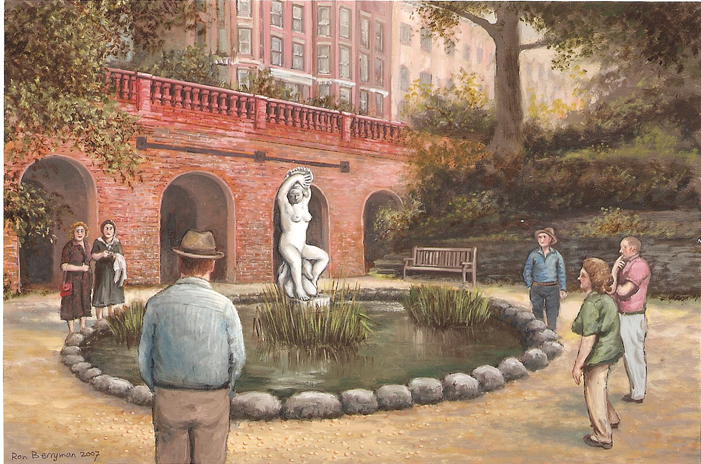
than Richmond’s notorious ‘Bulbous Betty’. This statue by
Alan
Howes now presides over the calm waters of a pool at the top of the
Terrace Gardens, eliciting little more then polite puzzlement among
passing pedestrians – neatly caught in this painting by Ron Berryman.
She seems wonderfully oblivious of the extraordinary furore she
provoked on her arrival there in 1952.
The setting is
appropriate, as her true title is ‘Aphrodite’, echoing perhaps
Botticelli’s painting of her birth off the coast of Cyprus. The style,
however, is that of the modernist idiom of the 1950s, and it excited
outrage among some of the councillors and even more of the citizens of
Richmond. Controversy raged in the letters columns of the Richmond and Twickenham Times,
‘Bulbous Betty’ being only one of a number of derisory nicknames
suggested in a heated correspondence that the editor brought to a close
after no fewer than 84 letters. She was described as being an insult to
human form, and schoolchildren were forbidden to look at her. One
letter declared the ‘the sculpture is as disturbing to gentlemen, as
Father Thames is to maidens’. Ron Berryman’s article, ‘The
Disgracing of Aphrodite’, wittily describes how she survived what
eventually became a matter for national debate.
Other articles
in the journal cover the development of Kew Road, the origins of a
Richmond pressure group, pleasant Sunday afternoons at the
Congregational Church and the odd case of a toddler lost and found on
the towpath in 1902.